By Oboh Linus, Lafia
The Global Initiative for Food Security and Ecosystem Preservation (GIFSEP) and stakeholders in Nasarawa State have advocated for a robust waste management policy to enhance the collection and recycling system, as annual waste generation reaches 730,000 tonnes.
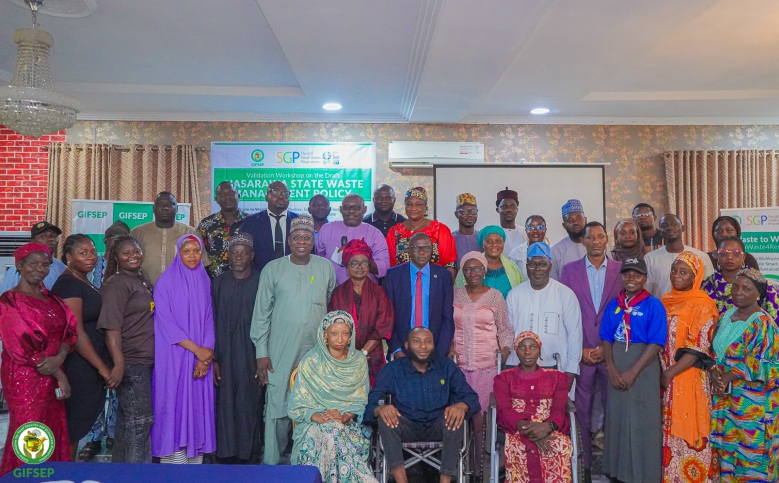
They made the appeal in Lafia during the Validation Workshop on the Draft Nasarawa State Waste Management Policy.
The GIFSEP, in collaboration with the UNDP Global Environment Facility (GEF) Small Grants Programme, is implementing “Waste to Wealth: Harnessing Bio-Waste Value to Enhance Climate-Smart Agricultural Production and Sustainable Livelihoods” in Nasarawa state.
Dr David Michael, Executive Director of GIFSEP, while speaking at the event, noted that sub-national policies were critical to waste management, as waste challenges were local and required context-specific solutions.
“Strong state-level policies can improve waste collection and recycling systems, promote waste-to-wealth opportunities, attract private sector investment, create jobs, and support climate action.
“And also strengthen coordination among communities, businesses, and government institutions,” he said.
According to Michael, solid waste management in Nigeria is a silent crisis that we can no longer afford to ignore.
“Nigeria generates an estimated 32 million tonnes of municipal solid waste annually, with only 20–40 per cent formally collected. The rest is openly dumped, burned, or discharged into the environment.
“In Nasarawa State, it is estimated that between 1,500 and 2,000 tonnes of solid waste are generated daily, amounting to nearly 730,000 tonnes annually, particularly from urban centres such as Lafia, Keffi, Karu and Nasarawa LGAs,” he noted.
He warned that poor waste management pollutes air, water, and soil, worsens flooding through blocked drainage, creates breeding grounds for disease vectors, and degrades farmland and aquatic ecosystems.
“Investment in waste management is an investment in public health, environmental protection, economic development, and our collective future,” he said.
Also speaking, Commissioner for Environment and Natural Resources, Margaret Elayo, said that the current framework, developed over a decade didn’t fully address plastic waste, organic waste and climate-linked waste streams
Commissioner, represented by Mr Ede Yakubu, Permanent Secretary in the Ministry noted that the draft policy aligns with the Climate Change Act 2021 and the Sustainable Development Goals.
“Let us use this opportunity to set a new standard for waste management in Nasarawa State—one that protects public health, safeguards our environment, and creates green jobs for our people,”
She said.
On her part, Dr Ibironke Olubamise, the National Coordinator of the United Nations Development Programme (UNDP) – Global Environment Facility (GEF) Small Grant Programme, said that the era of viewing waste as mere “trash” was over.
Olubamise, while highlighting the consequences of ignoring modern waste practices, warned that a dirty environment not only risks public health but could make the government appear dysfunctional.
“Environment does not need us; we need the environment. The environment does not forget, and it does not forgive. What you throw into it comes back to you. This is not a call for only environmentalists—it’s a call for everybody,” she warned.
She urged all citizens to take ownership of environmental protection, noting that flooding and poor waste management affect everyone, regardless of status or vocation.
The workshop brought together government officials, civil society groups, private sector actors and persons with disabilities to review and finalise the draft waste management policy and ensure it reflects current realities in the state. (NAN)