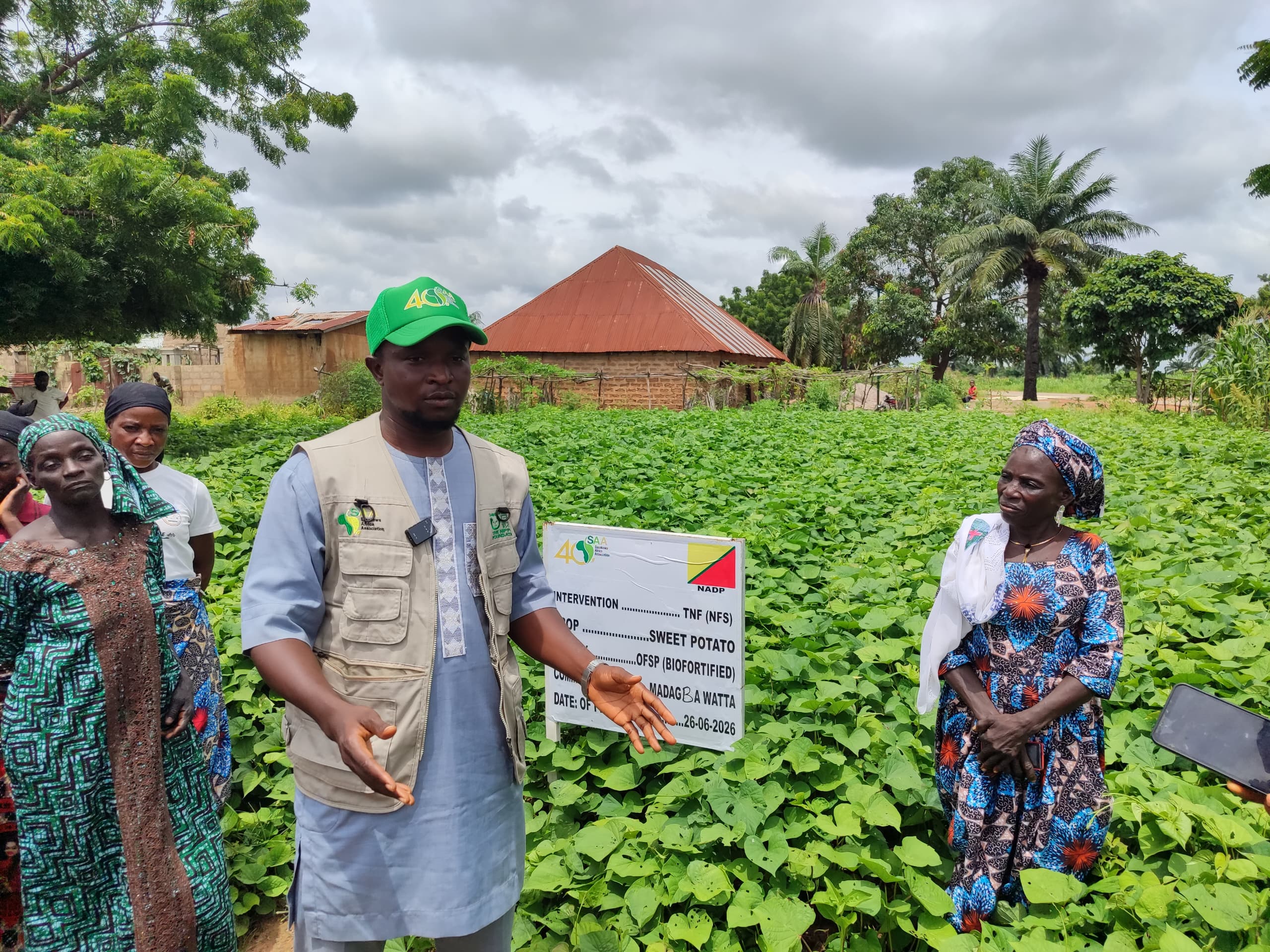
Smallholder farmers in Nasarawa have reported improved crop yields, soil health and household nutrition following the adoption of climate-smart agricultural practices and biofortified crop varieties introduced by the Sasakawa Africa Association (SAA-Nigeria).
The farmers spoke on Friday during media field days organised by SAA in Obi and Doma Local Government Areas (LGAs) of the state.
They said the interventions had exposed them to improved farming techniques, including appropriate plant spacing, improved seed varieties, biochar and compost application, proper fertiliser use and better field management.
Mr Jibril Elayo, a beneficiary at Tundun Adabu community in Obi, said adopting improved plant spacing and biochar application had produced visible results in maize and soybean production.
“Before now, you would hardly find a farmer planting just one seed per hole out of fear that it would not germinate.
“We adopted the SAA technology of planting one seed per hole at 25-centimetre spacing to achieve optimal plant density, which directly saves seeds, reduces cost and increases yield,” he said.
Elayo said SAMMAZ 52, an early-maturing Vitamin A-biofortified maize variety provided by SAA, had further improved farmers’ production prospects.
He said the variety, planted on the demonstration plot on June 26, was expected to mature earlier than conventional varieties, creating an opportunity for farmers to cultivate more than one crop cycle within a rainy season.
Mr Bashir Ogbole, Chairman of Ayinewoza Farmers Group in Obi, said there was a significant difference between crops managed with SAA-recommended practices and those cultivated through traditional methods.
“There is a major difference. Before, we paid little attention to spacing; we just planted. But anyone can see this managed field is far better.
“If the government helps farmers adopt these techniques statewide, food scarcity will be significantly reduced,” he said.
Mrs Adama Rabiu, a beneficiary from Angwan Hamidu community in Obi, said the intervention had also improved the quality and diversity of food available to her household.

“Since Sasakawa arrived, the food we eat has improved. We now cultivate fluted pumpkins around our living compounds to supplement our regular meals, which has made a major difference in our daily lives,” she said.
Mrs Sarah Joseph, a beneficiary from Angwan Iliya community in Obi, said the training had equipped farmers with improved techniques for cultivating Pro-Vitamin A biofortified maize, SAMMAZ 52, and improved soybeans.
She said the practices had produced healthier crops and raised expectations of higher yields, adding that farmers could achieve higher productivity on smaller plots of land.
Mrs Felicia Alaku, Chairperson of Madagba Watta Community Women Farmers’ Group in Doma, said SAA had introduced the group to orange-fleshed sweet potato (OFSP), which they had not previously cultivated.
Alaku said the farmers were trained on proper ridging and plant spacing, field management, fertiliser application, storage and preservation of planting materials, as well as different ways of preparing OFSP.
She said the farmers were also educated on the crop’s Vitamin A content and health benefits, particularly for children.
According to her, OFSP performed better than the traditional varieties cultivated by the farmers and had attracted interest from other farmers, with some already collecting vines from the group to establish the crop on their farms.
In his remarks, Dr Godwin Atser, Country Director of SAA, said the organisation served as a link between agricultural research institutes and smallholder farmers facing climate-related challenges.
Atser, represented by Mr Nathaniel Otene, Technical Coordinator, Climate Resilience and Agrifood System, said SAA focused on improving productivity and incomes by introducing drought-tolerant, early-maturing, high-yielding and pest- and disease-resistant crop varieties.
He explained that the biofortified maize, soybean and sweet potato varieties promoted by the organisation were products of conventional plant breeding and not Genetically Modified Organisms (GMOs).
According to him, some improved varieties mature within 80 days, compared with traditional varieties that take about 120 days, enabling farmers to secure their harvest where rainfall ends earlier than expected.
The country director said SAA was also promoting regenerative agricultural practices, including biochar application, organic composting and cereal-legume intercropping, to address declining soil fertility.
“Biochar is produced through pyrolysis and, when applied, it helps to retain soil moisture, while legume intercropping fixes nitrogen naturally into the soil.
“Rotating these crops restores and maintains long-term nutrient balance,” he said.

Dr Moshood Sulaiman, Programme Officer, Nutrition-Sensitive Agriculture, said SAA was promoting Pro-Vitamin A maize to address micronutrient deficiencies, particularly among pregnant women, nursing mothers and children under five.
Also, Mr Jonathan Yassah, Programme Officer, Market-Oriented Agriculture, said SAA was establishing decentralised seed production networks managed by local farmers to ensure sustainable access to quality planting materials.
Yassah said foundation seeds sourced from the Institute for Agricultural Research (IAR), Zaria, were being multiplied by local farmers for sale to other farmers within their communities.
Mr Moses Nongoatse, Communication Officer, SAA-Nigeria, said the organisation, in partnership with The Nippon Foundation (TNF) and the state Ministry of Agriculture and Food Security through the Nasarawa State Agricultural Development Programme (NADP), had implemented a multi-faceted agricultural development programme in seven local government areas across the state.
Nongoatse said more than 18,900 farmers had been mobilised and sensitised, while 15,975 received step-down training on improved agricultural practices, value-chain development and market-oriented farming.
He said SAA established 60 community demonstration plots, providing practical learning opportunities for about 600 farmers and reaching more than 2,000 others through wider outreach.
According to him, 3,950 farmers, including 885 women, were trained in post-harvest handling and nutrition, while biofortified crop plots and backyard gardens were established to promote access to nutritious food.
The News Agency of Nigeria (NAN) reports that the 2026 media field days provided an opportunity for journalists and agricultural stakeholders to inspect demonstration farms and interact directly with beneficiary farmers on the impact of the interventions. (NAN)