By Francis Nansak, Lafia
When General Sani Abacha announced the creation of six new states on 1st October, 1996, few gave Nasarawa a chance. Carved out of the old Plateau State, it was christened the “Home of Solid Minerals” but at birth, it had more solid problems than solid minerals.
Lafia, its chosen capital, was a sleepy local government headquarters with one tarred road, no secretariat, no government house, no water board, and civil servants operating from primary school classrooms. Thirty years after, as Nasarawa prepares to celebrate its pearl anniversary, the question is no longer whether the state exists, but whether the dream of its creation has been achieved.
This is the account of five men, five eras, and a people still in search of a common identity.
The Military Foundation: The Men Who Drew The Map (1996-1999)
The first Military Administrator, Wing Commander Abdullahi Ibrahim (rtd), had a simple mandate,he gave Nasarawa a shape. He established the administrative structure, created ministries. His successor, Colonel Bala Mande, completed the take-off,and conducted the transition to civil rule.
It was an era of blocks and blackboards. There was no money, but there was order.
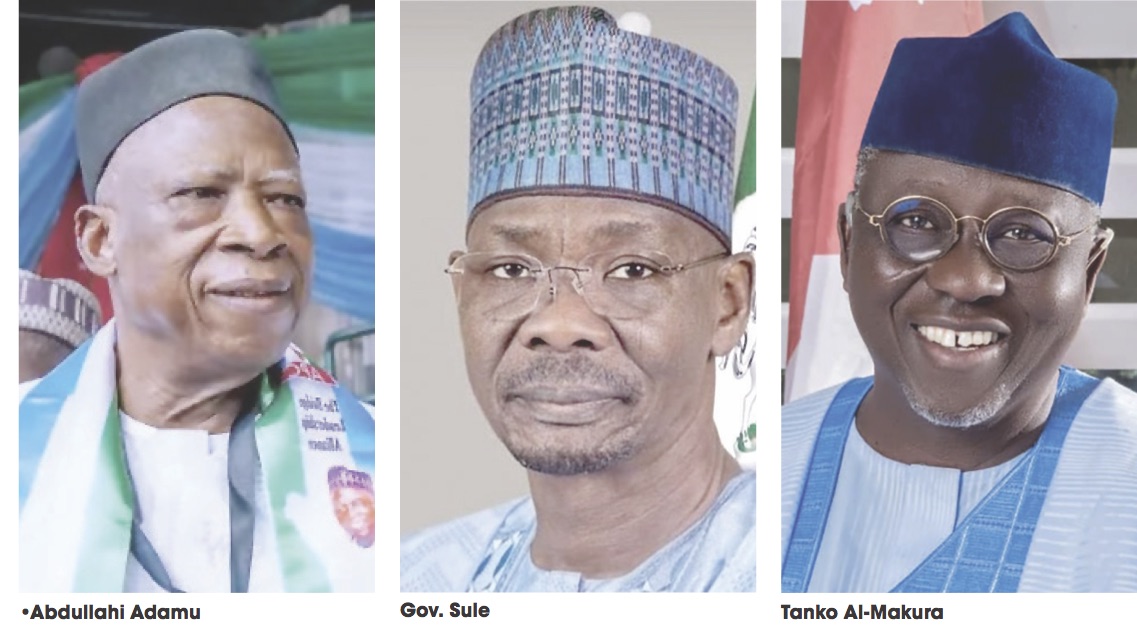
If Ibrahim gave Nasarawa a name, Abdullahi Adamu gave it a face. The first civilian governor, Senator Abdullahi Adamu of the Peoples Democratic Party (PDP), is still regarded as the town planner of Nasarawa.
Adamu met a rural outpost and attempted to build a capital city. He constructed the Government House, the State Secretariat, the Dalhatu Araf Specialist Hospital, the Lafia Square, and the Nasarawa State University, Keffi. He brought in the Fertilizer blending plant, and gave Nasarawa an urban outlook. For eight years, Lafia was a giant construction site.
But his era was not without criticism. His projects were called grandiose, his debt profile high, and his politics exclusive. He built structures, his critics said, but did not sufficiently build people.
The administration of late Aliyu Akwe Doma remains the most debated. Coming after Adamu, expectations were high, but his four years were plagued by industrial unrest, dwindling federal allocation, and later, an EFCC case over an alleged N15 billion fraud.
To his credit, Doma sustained the Nasarawa State University and tried to manage the fragile ethnic balance of the state, especially the farmer-herder tensions that exploded in 2008.
In the streets, however, his tenure is often described as the years the locusts ate, a period when governance slowed and the state lost momentum.
In 2011, history was made. Umaru Tanko Al-Makura, a businessman and then of the Congress for Progressive Change (CPC), broke the 12-year dominance of the PDP in Nasarawa. It was a political earthquake.
Al-Makura called himself the Architect of Nasarawa. And he was. He focused on urban renewal massive road construction in Lafia and Karu, the construction of model schools, the ultra-modern e-library, and the opening up of the Greater Karu axis that borders Abuja.
He made Karu the economic nerve-centre of the state and gave Lafia a facelift. His mantra was “Seeing is Believing.”
His critics accused him of concentrating development in Nasarawa West (Keffi, Karu, Nasarawa) at the expense of the South and North, and of running a government of friends and family.
If Senator Abdullahi Adamu being the first elected Executive Governor, Senator Umar Tanko Al-Makura who was number Three after late Alhaji Akwe Doma, was the Architect of Modern Nasarawa State and was succeeded by Engr. Abdullahi Sule who became the fourth elected governor as the Engineer of the state and industrializer.
Governor Abdullahi Sule is a former Managing Director of Dangote Sugar, Sule came with a boardroom mentality. He did not just want to share federal allocation; he wanted to create wealth. Through the Nasarawa Investment Development Agency (NASIDA), he has courted investors in lithium mining in Nasarawa LGA , agriculture in Doma and Awe, and solid minerals across the state.
His administration has delivered the Lafia Cargo Airport, the Keffi Square and Bus Terminal, the dualization of Shendam Road, and the completion of over 30 rural roads. He has also been praised for financial prudence, prompt payment of salaries, and relative peace.
Yet, on the streets, the verdict is mixed. The elite applaud his transparency and investor-friendly approach. The ordinary people complain that while infrastructure is rising, poverty and unemployment remain biting. Flyovers do not put food on the table, they say.
“We appreciate the fact that the state has moved from a slump into an enviable habitat,but we still need to have a belonging, the kind of belonging that the small scale business woman and the youth can enjoyed direct benefit from government and shouldn’t be all about civil servants.
However and on the contrary,Comrade Matthew Tukura applauded the impact made by those that had governed and still governing.He said there is a significant shift from the present Nasarawa State from when it was created
According to him, the real face of Nasarawa State began in earnest during the civilian regime ,with senator Abdullahi as the master planner and administrative structuring.
“Thirty years after creation, Nasarawa has undeniably moved from dust to dream. From a town with one tarred road to a state with a university, a polytechnic, a specialist hospital, an airport, and a gateway to Abuja that houses over two million Nigerians”Tukura averred.
But the biggest challenge remains. At 30, Nasarawa has achieved statehood but is still struggling to achieve nationhood.
A pundit in a simple term reacted thus” We are still Eggon, Alago, Mada, Gwandara, Migili, Hausa, Fulani before we are Nasarawans. Politics is still defined by zones .West, North, South rather than by a collective Nasarawa agenda.
“Ethnic clashes, farmer-herder conflicts, and indigene-settler disputes have repeatedly tested the state. Governance has been about brick and mortar, but the next 30 years must be about building people, building unity, and building an economy that can survive without Abuja” The pundit submitted.
As Nasarawa turns 30, it stands at a crossroads. The foundations have been laid by soldiers, the structures by civilian governors, the facelift by modernizers, and the economy by an engineer. The next chapter must be about the people.
The infant of 1996 is now a man. It is time for him to leave his father’s house and fend for himself.
This is one expectation from the people as the state prepares for the next election to filled in a successor .The question is would the new bride of Nasarawa State come 2027 continue from the legacies of the previous administrations , advanced livelihood and create a more secure citizens? The answer lies with those canvassing to succeed Engineer Abdullahi Sule.