By Emmanuel Antswen
The Nigerian Air Force (NAF) has reaffirmed innovation as a critical driver of operational effectiveness in a technologically driven service.
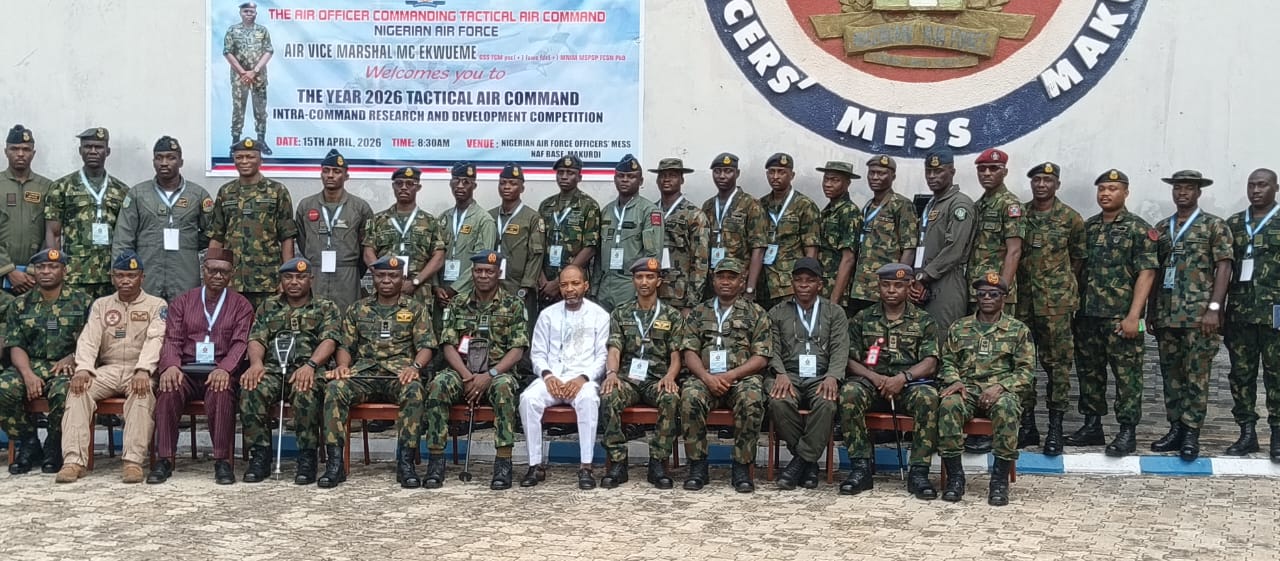
The Air Officer Commanding, Tactical Air Command, Makurdi, AVM Michael Ekwueme, said this during an intra-command research competition in Makurdi on Wednesday.
Ekwueme described the competition as “a strategic platform to generate practical ideas, foster collaboration, and strengthen intellectual capacity within the command”.
He said the initiative underscored NAF’s commitment to innovation as a cornerstone of operational effectiveness.
According to him, sustained research will drive technological independence, enhance readiness, and address evolving security challenges.
The AOC stressed the need to build a strong innovation culture through experimentation, problem-solving, and locally driven solutions, especially in fleet serviceability and logistics.
“This event reflects the unwavering commitment of the Nigerian Air Force to institutionalising innovation as a core driver of operational excellence,” he said.
Ekwueme highlighted the importance of research in modern warfare, noting it remains fundamental to contemporary air power.
“In today’s rapidly evolving security landscape, research and development is indispensable to modern air forces.
“Globally, leading air forces recognise that technological superiority and indigenous innovation provide decisive advantages,” he said.
He added that nations investing in local research are better placed to achieve sovereignty, reduce external reliance, and ensure long-term mission sustainability.
The AOC emphasised decentralised innovation, alignment with global best practices, and stronger collaboration with academic institutions.
He urged participants to remain proactive and solution-driven, expressing confidence in their contributions to the Force’s long-term strategic goals.
“In modern military institutions, research is no longer confined to defence industries. It thrives where real-time challenges inspire practical solutions.
“Many air forces adopt decentralised frameworks to develop and refine systems suited to operational needs,” he said.
He added that the Tactical Air Command must align with global best practice by promoting locally driven solutions supporting national defence.
Announcing results on behalf of the assessors, Jonathan Enokela said all 14 projects targeted Nigeria’s security challenges.
He said the 109 Combat Reconnaissance Group, Gombe, won with a GSM-based motion intrusion alert system to protect critical assets.
The 153 Base Service Group, Yola, came second for developing a smart helipad lighting system.
The 107 Air Maritime Group, Benin, was recognised for an integrated ATR 42-500 aircraft maintenance management software. (NAN)