By Aloysius Chiahemba, Makurdi
The stock valuation of the Benue Investment and Property Company (BIPC) has risen from ₦7.95 billion to ₦25.15 billion in three years under the administration of Governor Hyacinth Alia, representing an increase of about ₦17.2 billion.
The Managing Director and Chief Executive Officer of BIPC, Dr. Raymond Asemakaha, disclosed this while highlighting the achievements of the company under the present administration.
According to him, BIPC had a total stock valuation of ₦7,949,075,082.30 when the current management took over three years ago.
He said the company at the time was largely surviving on the sale of shares and properties, while several of its assets and industrial facilities were either underutilised or inactive.
Asemakaha said Governor Alia, upon entrusting the management of BIPC to his team, challenged it to move beyond managing existing resources and focus on creating wealth through production and investment.
He said the directive became the foundation of the company’s restructuring and investment strategy.
The BIPC boss said the company had since embarked on the revival and development of several industrial and commercial projects aimed at adding value to locally produced agricultural commodities and creating employment opportunities.
Among the projects, he listed the Food Basket Brewery, Bensono Concentrate Factory, Benval Juice Factory, BIPC Bakery and Water Factory, Eco City projects, Taraku Mills and Macafa Park.
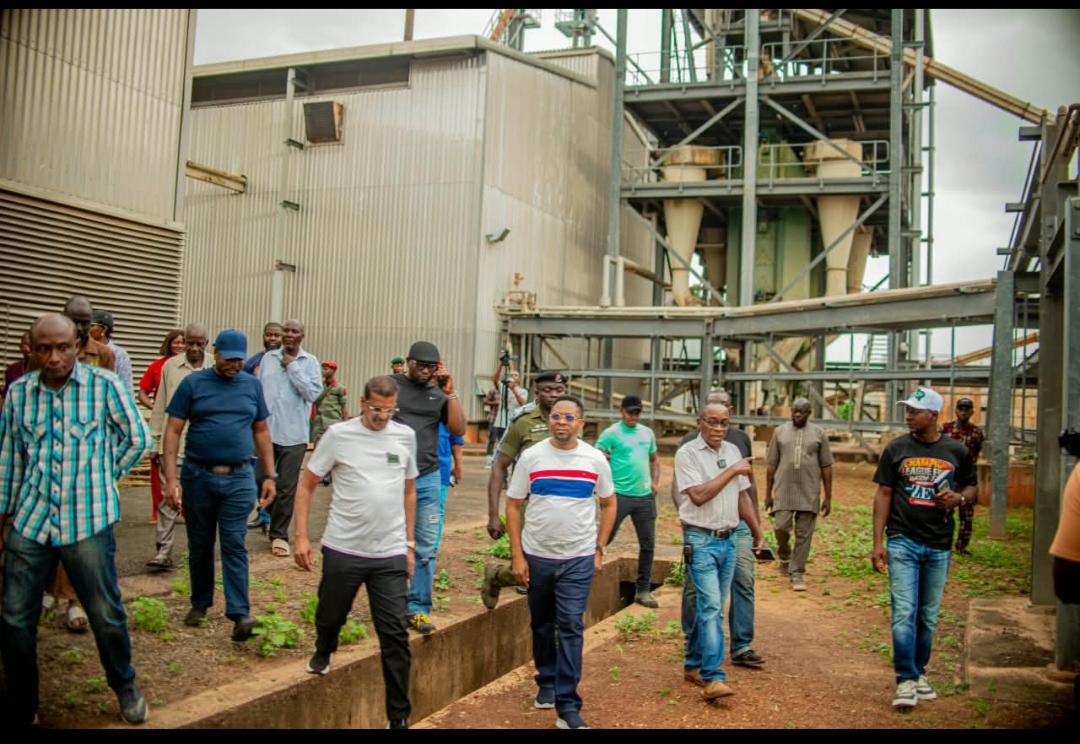
According to him, Bensono Concentrate has been revived and equipped with a fully automated production line capable of producing 40,000 bottles per hour, while Benval Juice Factory, located at the Industrial Layout, Makurdi, is about 95 per cent complete.
He added that the BIPC Bakery and Water Factory had commenced operations, with plans to launch its Otukpo branch in November.
Asemakaha also disclosed that Taraku Mills had commenced test-running, with the production of cake underway and Golden Soya Oil expected to be introduced to the market soon.
He said the activation of the Taraku asset, which he valued at about ₦70 billion, would enable farmers to process their agricultural produce locally rather than selling raw commodities.
The GMD further disclosed that BIPC’s printing and nylon factory was now producing for markets in Benue and neighbouring states, including Taraba and Nasarawa.
He said the company was also undertaking the valuation, geo-fencing and Geographic Information System (GIS) mapping of its assets through Knight Frank, while its corporate structure and investment policies had been reviewed.
Asemakaha said BIPC had engaged KPMG International for its restructuring, including corporate governance and investment policy reforms, while PKF Professional Services serves as its auditor.
He added that the company was working towards listing on the Nigerian Exchange (NGX).
On employment, the GMD said BIPC had grown from 121 staff members at the time of handover to about 784 employees, with additional recruitment expected for some of its new and revived enterprises.
He attributed the growth in the company’s asset valuation to what he described as a deliberate shift from asset disposal to production, industrialisation and value addition.
According to him, BIPC’s current stock valuation stands at ₦25,150,927,722.63, compared with ₦7,949,075,082.30 three years ago.
He said the difference represented a net increase of approximately ₦17.2 billion and described the development as a significant increase in the value of the state-owned company.
Asemakaha argued that the increase should be viewed as part of a broader strategy to build sustainable state-owned enterprises capable of generating revenue, creating jobs and retaining wealth within Benue.
He said BIPC’s strategy was anchored on sourcing raw materials locally rather than relying heavily on imported inputs.
“We did not go to China to import. We went to the farm to aggregate,” he said, stressing the company’s emphasis on local production and agricultural value addition.
The GMD also said BIPC had received favourable ratings and was implementing reforms aimed at strengthening its corporate governance and attracting investment.
He cited the restructuring of the company, ongoing asset valuation and the development of new industrial ventures as evidence of efforts to position BIPC as a commercially viable state-owned enterprise.
Asemakaha said the company’s long-term objective was to transform BIPC from an entity largely dependent on asset sales into a productive investment institution capable of generating sustainable wealth for the state.
He described the development as “generational savings,” arguing that the value being built into BIPC’s assets would benefit not only the present administration but future generations.
He said the company’s industrialisation drive was consistent with the administration’s broader economic agenda of promoting agriculture, manufacturing, employment and local value addition.
“From handover to heritage, from ₦7.9 billion to ₦25 billion, the story has just begun,” Asemakaha said.