By Emmanuel Antswen
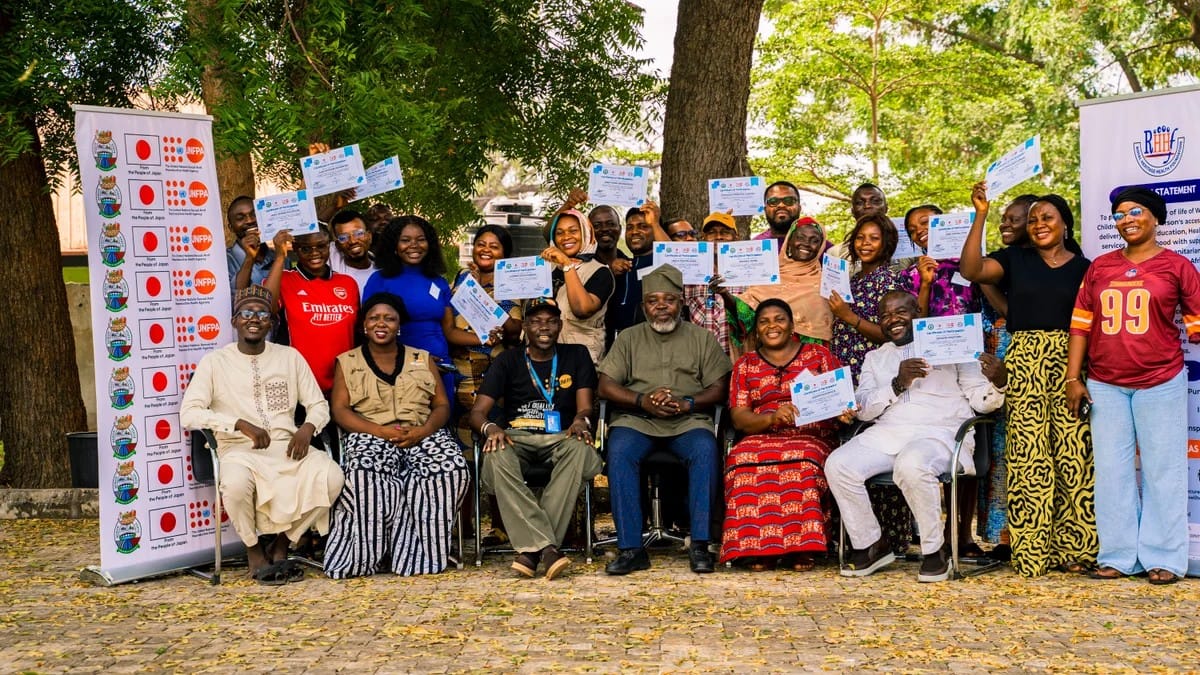
Participants at a five-day training on digital literacy and Artificial Intelligence (AI) in Benue have commended the organisers for equipping them with practical skills to improve their work and empower communities.
The News Agency of Nigeria (NAN) reports that the training which began on Tuesday is organised Benue Ministry of Youth, Sports and Creativity, in collaboration with the Royal Heritage Health Foundation (RHHF), supported by the United Nations Population Fund (UNFPA) and funded by the Government of Japan.
The 120 participants, drawn from various ministries, organisations and institutions, said the training had enhanced their understanding of digital tools, AI applications, digital marketing and responsible use of technology.
They also pledged to cascade the knowledge to young people, women and other vulnerable groups to promote digital inclusion and economic empowerment.
Mr Jack Uma, Tech Lead at the University Pod (UniPod), Moses Orshio Adasu University Makurdi, a Timbuktoo initiative of the United Nations Development Programme (UNDP), said the training would help him establish community-based digital skills programmes.
Uma said the knowledge acquired would enable people to apply AI in their businesses and daily activities, while creating opportunities for unemployed persons to explore content creation and digital marketing.
“I plan to set up a short course for community members and ensure that people are trained quarterly.
“The knowledge is not meant to be kept to myself but extended to others,” he said.
Mrs Comfort Tyorough, an official of the Benue Ministry of Education, said the training had exposed her to several AI tools that could improve data collection, analysis and planning in the education sector.
Tyorough said she had previously relied mainly on ChatGPT but discovered other digital tools for producing videos, photographs, music and other content.
She said the knowledge would help her move from manual processes to more efficient digital methods, particularly in collecting school data for projections and education budgeting.
Mrs Ngunengen Azoom, Acting Director, Department of Planning, Research and Statistics, Benue Ministry of Youth, Sports and Creativity, said the training had improved her capacity to use AI in report writing, speech preparation and monitoring of programmes.

Azoom said the knowledge would also enhance her ability to train youths on responsible use of digital devices and explore opportunities for income generation.
She commended the Royal Heritage Health Foundation (RHHF), the United Nations Population Fund (UNFPA), the Benue Government and other partners for providing the training free of charge.
Mr Nick Eworo, Benue Commissioner for Youth, Sports and Creativity, represented by Mr Emmanuel Wende, Director of Administration and Supply, said the programme was important in equipping youths with skills needed in the digital age.
Eworo said knowledge remained a major driver of development, adding that young people were not only leaders of tomorrow but also the manpower needed for development today.
He urged participants to take the training seriously and share the knowledge with others, noting that its impact would be measured by how effectively it was transferred to communities.
“Knowledge matters when it is shared and when it impacts society.
“It will be a total loss if you keep it to yourself,” he said.
The commissioner said the ministry was ready to sustain its partnership with RHHF and UNFPA in promoting youth development and digital skills acquisition.
Dr Adama Yusuf, Gender- Based Violence (GBV) Specialist, with UNFPA said the training was designed to build a pool of facilitators capable of extending digital literacy and AI knowledge to women, adolescent girls, young people and vulnerable communities.

Yusuf said the programme covered digital literacy foundations, AI fundamentals, practical applications, responsible use, online safety, cybersecurity and action planning.
The GBV specialist said participants were expected to conduct at least two rounds of cascading training before the programme ended.
She urged facilitators to deliver the training in English, Hausa and other relevant local languages to ensure wider access and understanding.
Mr Muhammad Audu, an AI engineer and facilitator, said the training introduced participants to basic digital tools, internet use, AI applications, digital marketing and safe use of emerging technologies.
Audu said the train-the-trainers approach would enable participants to transfer the skills to others, thereby improving productivity and creating social and economic opportunities.
He said the initiative would promote responsible use of technology in Benue and beyond.
The training formed part of efforts to strengthen digital inclusion and equip communities with practical skills for education, employment and economic activities. (NAN)