By Francis Nansak, Lafia
A non-governmental organization, Fasasi Youth Foundation, has graduated 24 fellows out of 50 applicants who earlier applied for admission.
Speaking to a select team of journalists, the Founder and Chief Executive Officer, Mr. Fasasi Sadiq, said the foundation was set up to enhance the leadership capacity of youths across tertiary institutions in Nasarawa State.
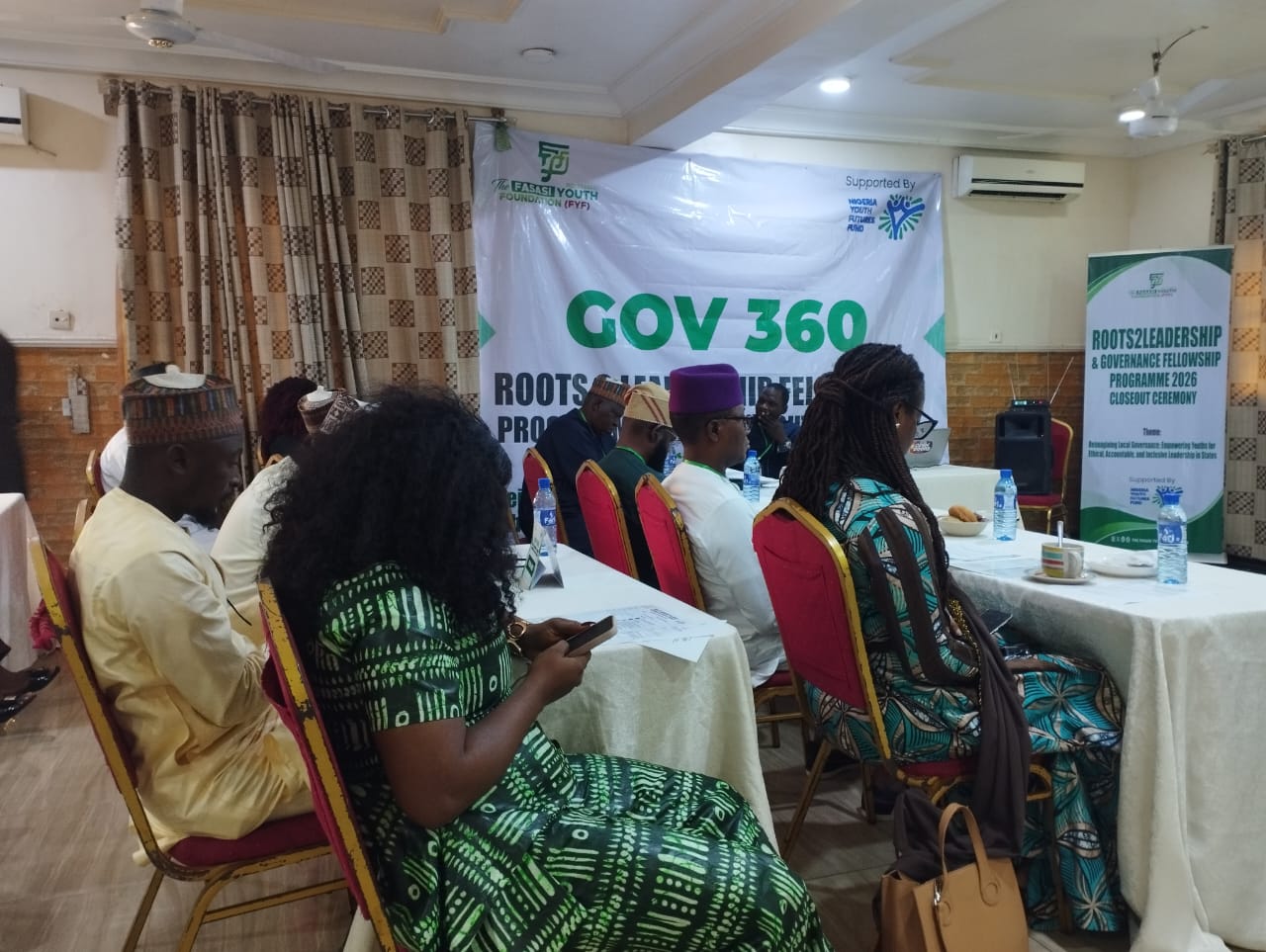
Fasasi made the statement on Saturday in Keffi during the Roots2 Leadership Fellowship Programme 2026 Closeout Ceremony with the theme: _“Reimagining Local Governance: Empowering Youths for Ethical, Accountable and Inclusive Leadership in States.
According to him, the foundation received about 200 applications from inception, but only 50 persons were selected.
“This is because we carefully selected those 50. Over the years, people have been disconnected from grassroots leadership. If you want to become LG Chairman, a member of the House of Assembly, or even get to the National Assembly, you need to start your politics from the grassroots. This will make people demand accountability from local governance. That is what led to the GOV 360 Grassroots Leadership Project,” He said.
The closeout ceremony featured goodwill messages from notable NGO chief executives, including Dr. Elizabeth Agbiti Douglas, Project Director, Nigeria Youth Futures Fund, who noted that leadership is not a gift but a practice. Others in attendance included the Deputy Registrar and Secretary, Centre for Research and Documentation, College of Education, Akwanga, and the Deputy Chairman of Kokona Local Government, Hon. Mohammed Adah Usman, among others.
Highlighting the successes and outcomes of the Roots2 Leadership and Governance Project, the Project and Operations Officer of Fasasi Youth Foundation, Otene Ojimaojo Eunice, revealed that the project was established with one clear objective: to nurture a new generation of ethical, informed and service-driven young leaders who will actively contribute to good governance and sustainable development in Nigeria.
According to her, 50 persons were selected as beneficiaries, while 72 could not make it. “Out of the 50 persons, only 47 were confirmed as participants and only 24 made it for graduation as fellows. Throughout this fellowship, we successfully coordinated a series of interactive learning sessions that equipped our fellows with practical knowledge and leadership skills,” Otene added.
The event also featured a panel session on “Building Ethical Leadership for Democratic Renewal: The Role of Universities, Government and Civil Society.” Certificates were presented to the 24 successful participants.